Technology
Advanced Battery Technology
Performance starts long before pack assembly. It begins with chemistry choice, thermal pathways, firmware logic, and the practical storage-story emphasis that customers now expect to see clearly: safer materials, stronger charge behavior, and energy storage options that suit real infrastructure.
Six Engineering Pillars
280 Wh/kg
High Energy Density Architecture
Our cell-to-pack integration eliminates intermediate module housing, reducing dead weight by 18% and increasing usable energy density to 280 Wh/kg. Every cubic centimeter is engineered intentionally.
7-Layer Protection
Enhanced Safety Architecture
Seven independent protection layers operate simultaneously: overcurrent, overvoltage, under-voltage, over-temperature, short-circuit, cell imbalance, and isolation fault detection. Thermal runaway containment is validated to IEC 62619.
3,000+ Cycles
Extended Lifecycle Engineering
Precision cell matching within ±2% capacity tolerance at pack assembly, combined with adaptive balancing algorithms, extends pack life beyond 3,000 cycles while maintaining over 80% capacity retention — exceeding industry standard by 40%.
48 Parameters / Cell
Intelligent Battery Management
Our in-house BMS firmware continuously monitors 48 parameters per cell, running Kalman-filter SOC estimation and predictive SOH algorithms. Real-time data is accessible via CAN bus or optional cloud dashboard for fleet operators.
<2°C Variance
Advanced Thermal Management
Passive cooling (phase-change materials + heat spreaders) and active liquid cooling options maintain cell temperature variance below 2°C across the pack during peak load — critical for long-term cycle life and safety in high-ambient environments.
60% Lower Lifecycle CO₂
Second-Life & Sustainability
Every Nordische battery is designed with end-of-life reuse in mind. Packs reaching 80% capacity after EV use are recertified and redeployed in stationary storage applications, reducing lifecycle carbon footprint by an estimated 60%.
BMS Deep Dive
A Battery Management System continuously measures voltage, current, temperature, insulation state, and cell balance. At Nordische, the BMS does more than protect. It predicts, calibrates, and informs. Kalman-filter SOC estimation, SOH forecasting, and event logging support smarter charging strategies, warranty analysis, and fleet-level optimization.
7-Layer Protection Stack
- Overcurrent detection
- Overvoltage cut-off
- Undervoltage protection
- Over-temperature shutdown
- Short-circuit isolation
- Cell imbalance management
- Isolation fault detection
Thermal runaway containment and protective logic are validated against IEC 62619 expectations for industrial and stationary systems.
Energy Storage Platforms
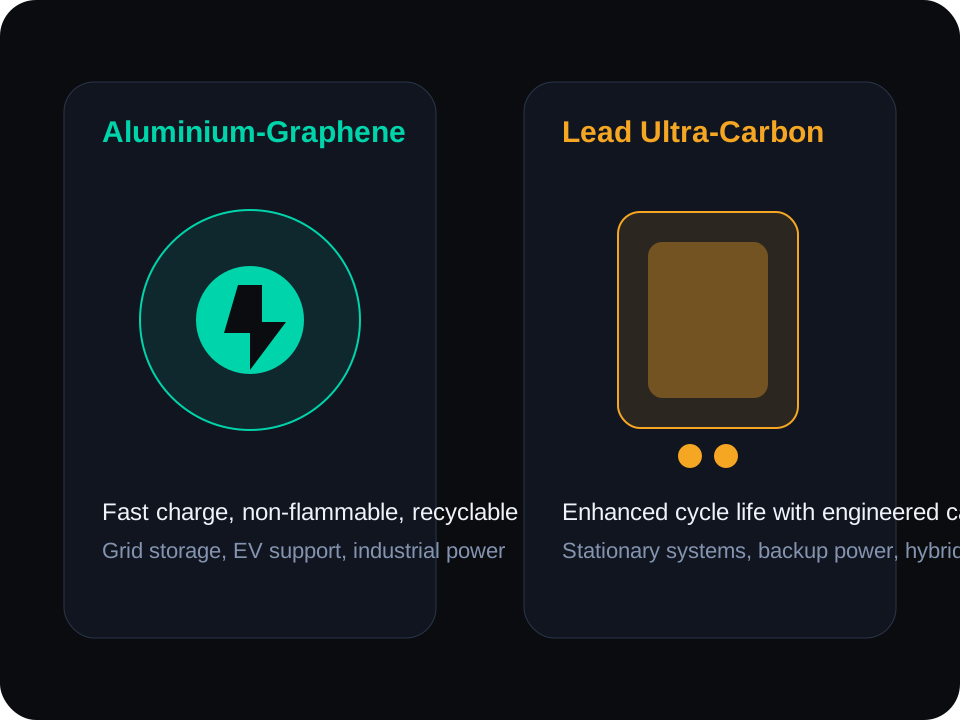
The reference site strongly emphasizes differentiated storage chemistry. We now surface that same message here with clearer focus on aluminium-graphene and lead ultra-carbon platforms.
Aluminium-Graphene Battery
A safer, non-flammable storage platform designed around fast charging, strong power delivery, and recyclable material availability beyond lithium-heavy supply chains.
Lead Ultra-Carbon Battery
An upgraded lead-based architecture using engineered carbon materials to improve cycle life, charge acceptance, and deep-discharge resilience for stationary applications.
Chemistry Comparison
| Chemistry | Best For | Trade-off |
|---|---|---|
| NMC | High-energy EVs and mobile platforms | Higher thermal control requirements |
| LFP | Stationary storage and telecom backup | Lower energy density |
| LTO | Extreme fast charge and harsh climates | Higher cost per kWh |
Decision guide: prioritize NMC for vehicle range, LFP for lifetime economics, and LTO where rapid charge acceptance or extreme temperature resilience dominates the brief.
Our R&D Investment
We allocate 12% of annual revenue to research and validation. That funds in-house thermal chambers, vibration rigs, firmware benches, and accelerated aging campaigns that de-risk client deployments.
- • In-house testing and prototyping
- • Rapid firmware iteration on NXP and STM32 platforms
- • Patent portfolio focused on integration and thermal control